
After Hoffmann-Hayman ceased roasting in 1972, much of the company’s story on this site stops at packaging, newspaper ads, and the Delaware Street building itself — including the weathered “Old Roaster” switch box still mounted on the factory wall. A less familiar thread is where the plant’s production hardware went. Two Texas publications describe Bolner’s Fiesta Brand — the San Antonio spice company founded in 1955 — picking up industrial coffee-grinding equipment from H and H and putting it to work on spice, especially pepper.
Reporting (not primary records here). Texas Monthly, in a company history feature, quotes Tim Bolner on the family buying a “$50,000 grinder” for “$100 from the closing H and H Coffee Company” — a machine that needed rebuilding but was still in service grinding pepper. Texas Highways puts the transfer in 1971, describing an “industrial coffee grinder purchased … from San Antonio’s H and H Coffee” used for peppercorns today.
Innovation doesn’t end with these mixtures, either. About five years ago, Bolner’s bought a sifter for their black pepper in a new size that sloughs off the outer shell, leaving just the meat of the peppercorn. This development means home cooks can have access to the famous 16-mesh pepper beloved by pitmasters like Tootsie Tomanetz of Snow’s BBQ, where it’s used to lend a jewel-like bark to brisket. Some things never change, though. Before sifting those peppercorns, they are ground in another massive machine with decades’ worth of service: an industrial coffee grinder purchased in 1971 from San Antonio’s H and H Coffee.
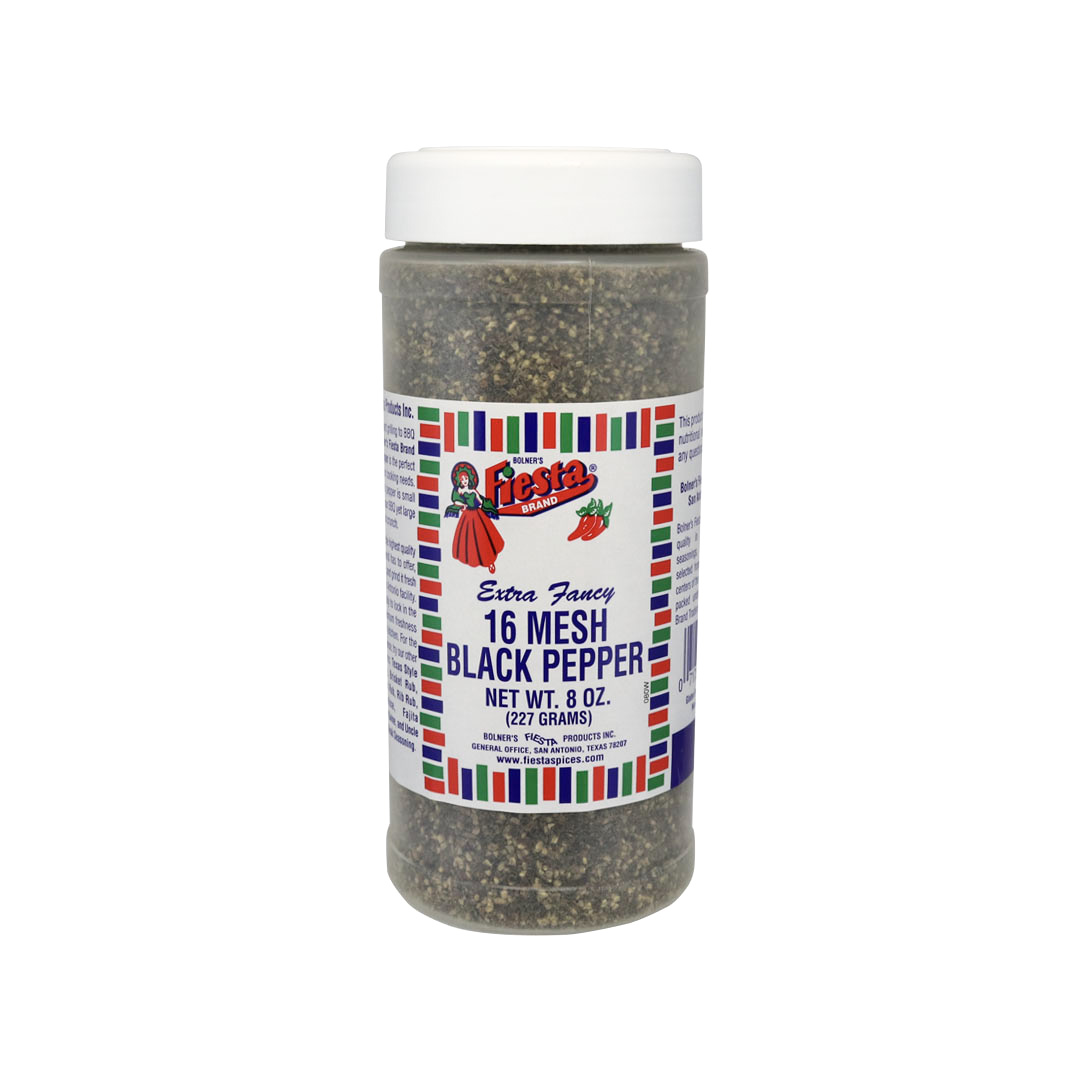
Retail packaging for the 16 mesh black pepper line discussed in the Texas Highways piece above—not the industrial grinder itself, but the kind of finished grind that reporting ties (upstream) to Fiesta’s pepper operation.
Treat the price, model, and exact calendar date as journalism until matched to invoices, auction notices, or a Bolner family oral-history deposit. Even so, the anecdote matters for this archive: it is one of the few public narratives about H and H plant assets living on inside another San Antonio food business — a coda to the roastery’s commercial grinders and mills after the coffee labels went quiet.
Sources (full citations)
These are the two secondary pieces the draft already summarizes; details below are for cites and image rights.
Texas Monthly — José R. Ralat, “How Bolner’s Fiesta Brand Spices Came to Dominate Texas Cooking”, Texas Monthly (web; magazine footer on the article links the April 2026 issue). Tim Bolner (president, Bolner’s Fiesta Products), interviewed in the piece, is quoted on purchasing a “$50,000 grinder” for “$100 from the closing H and H Coffee Company,” with rebuilds over time; the machine “remains in use today as a pepper grinder.” Accessed 29 April 2026.
Texas Highways — Sara Marie D’Eugenio, “Spice Things Up With Bolner’s Fiesta Products”, published online 30 December 2024 (noted at top of article); also carried in the December 2024 print issue. Chris Bolner (VP of sales), on a plant tour, describes peppercorns ground in “an industrial coffee grinder purchased in 1971 from San Antonio’s H and H Coffee” before newer sifting steps. Accessed 29 April 2026.
Neither article substitutes for a dated newspaper classified, auction notice, or invoice.
Images (research)
- This post: one collection photograph —
assets/images/gallery/2024-01-15-bolners-fiesta-16-mesh-black-pepper-8oz.jpg/ matching thumbnail (10279-20240115.jpgfrom intake, 15 Jan 2024) — Extra Fancy 16 Mesh Black Pepper retail bottle, tying the Texas Highways 16-mesh discussion to a labeled product (not the grinder itself). - Texas Monthly embeds several photographs “Courtesy of Bolner’s Fiesta Brand” (e.g. family archival photo, founder portrait, product display). Those rights sit with Bolner’s / the magazine — do not copy into
/assets/images/for this site without permission. - Texas Highways is a reported plant visit with scene-setting (lobby, packaging line, historical packaging case). Treat any reuse of their photography the same way: request permission before hosting a derivative here.
- Old Roaster switch box (
HandH-Old-Roaster-Door-ig.jpg) remains useful cross-linked prose illustration for H and H factory hardware; this draft’s header teaser instead foregrounds the 16-mesh pepper bottle so the listing matches the new figure. - To illustrate the actual grinder: ask Bolner’s / the magazines for a one-time web license, or photograph it yourself during an authorized tour (their facility is at 426 Menchaca St., per Texas Highways).
Newspaper and primary records (research)
-
Contemporaneous clipping not in this repo: No San Antonio daily or trade-paper item has been filed here that names Bolner and H and H together for a 1971 equipment sale. Worth searching San Antonio Express / Express-News, Light, News, business columns, and Noland’s-style industrial notices (see Newspaper Clippings); also Newspapers.com, Portal to Texas History, and Secretary of State / UCC or chattel filings if any bill of sale surfaced.
-
Same-era context (this site): [H and H advertisement — San Antonio Express, 22 June 1971]({% post_url 1971-06-22-san-antonio-express-tue-jun-22-1971 %}) — metro ad placement in 1971; it does not mention Bolner or equipment.
Further research: factory liquidation notices, 1971–1973 equipment sales, Bolner company archives, or photographs of the grinder in Fiesta’s plant would tighten the story. Leads welcome via contact.