
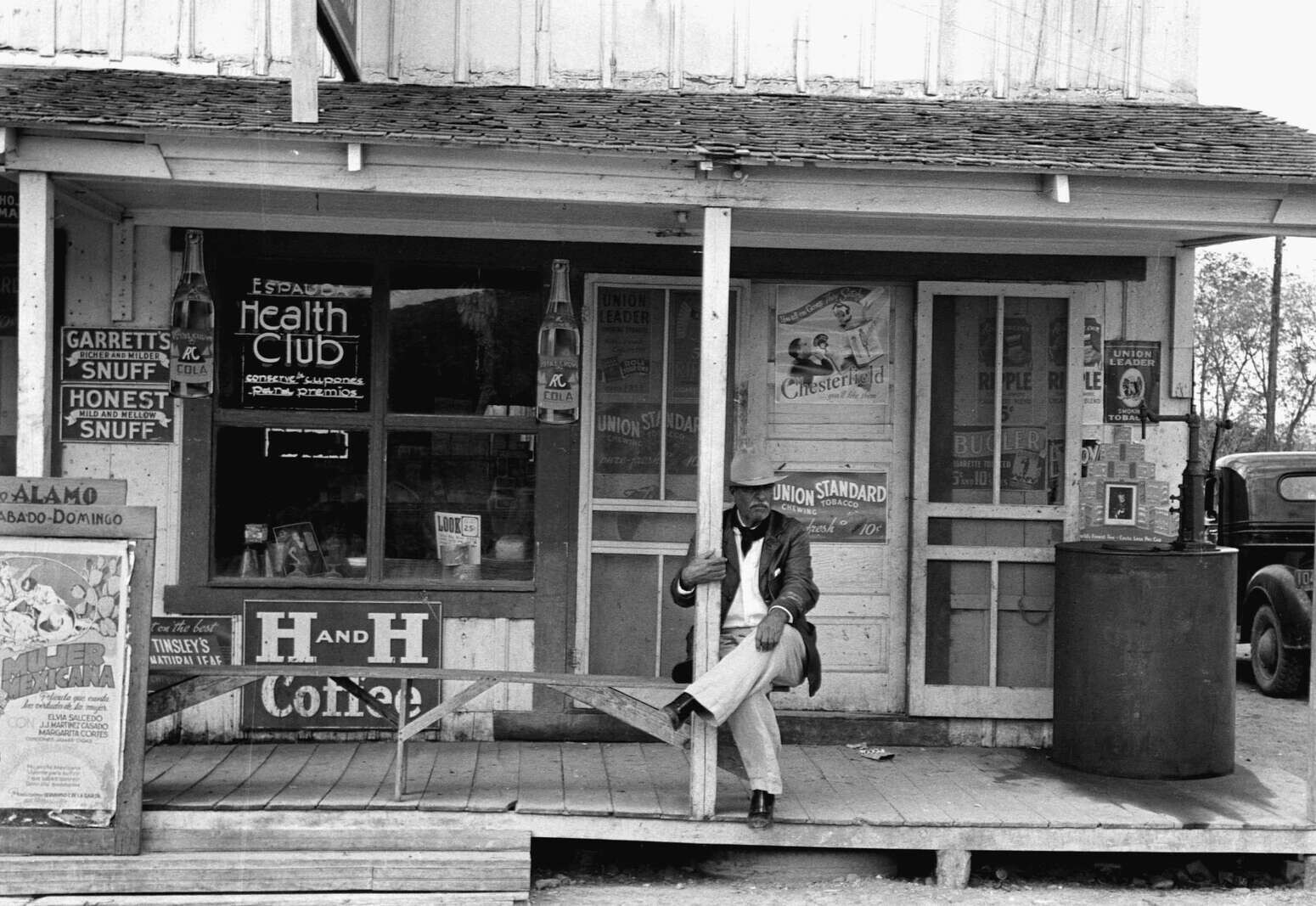
A remarkable reference frame — a black-and-white documentary photograph of a rural general-store porch somewhere in South Texas in the early 1940s, with a large porcelain-enamel “H AND H Coffee” sign mounted on the porch railing directly facing the street, embedded in one of the densest pieces of period commercial signage you’ll see on a single storefront. Photographer, archive, and precise town are not yet confirmed from our end; the frame is almost certainly either an FSA / Office of War Information government documentary photograph from 1942–43, or a contemporary news / commercial documentary image in the same style. We’re filing it in the Reference gallery as an in-situ retail-use photograph of an H and H Coffee sign and treating the attribution and location as open questions.
Dating the photograph
Two independent cues in the frame put this photograph firmly in the early 1940s, and almost certainly 1942 or shortly after:
- The movie poster at left. Leaning against the porch post at the left edge of the frame is a printed Spanish-language movie poster for the ALAMO theater’s Saturday–Sunday (SABADO – DOMINGO) showings. The film is “MUJER MEXICANA” and the cast list reads “ELVA SALCEDO / J.J. MARTINEZ CASADO / MARGARITA CORTES”. That identifies the film as Mujer Mexicana (1942), directed by Miguel Contreras Torres — a release of the Mexican Golden Age cinema of the early 1940s. The poster’s presence means the photograph cannot predate the film’s release and is most naturally read as near-contemporary with it.
- LOOK magazine at 25¢ in the window display. Visible on the window sill through the glass, a copy of LOOK magazine priced at 25¢. LOOK was a popular weekly photo-magazine (founded 1937) that sold at 25¢ through much of the 1940s — consistent with the film-poster dating rather than contradicting it.
Taken together, the dating window sits within the FSA photographic project’s 1942–43 OWI transition period — which is the era in which most of the major federal documentary photographers (Russell Lee, John Vachon, Marion Post Wolcott, and others) were working in South Texas and the border counties. The style of this frame — frontal, eye-level, patient attention to commercial signage, an individual subject placed into the storefront as a social anchor — is the signature FSA/OWI approach to small-town commercial photography. We note the style match but do not attribute the photograph to any specific photographer or archive until an archival source is confirmed.
Locating the photograph
Several cues point to a South Texas / Mexican-American (“Tejano”) community:
- The Spanish-language movie poster and the Alamo theater as the venue.
- A hand-lettered Spanish-language window sign reading “ESPAUDA Health Club / Conserve su…” (the tagline runs off the crop; “ESPAUDA” is transcribed here as the sign-painter wrote it — the first word is uncertain and could be a local family name, a place reference such as a neighborhood [Espada is a San Antonio locality, e.g.] or a phonetic rendering — happy to be corrected by anyone who recognizes the business).
- The presence of the Mexican Golden Age cinema poster pinned to the porch post as everyday community advertising, rather than as something unusual.
South Texas Tejano towns that the FSA/OWI documented extensively in this period — Crystal City, Robstown, Laredo, Eagle Pass, Brownsville, and numerous smaller communities — are all candidates. Until a caption or archival record is located, we leave the location as “a South Texas Tejano community, most likely in the 1942–1943 window.”
The signage inventory (what’s actually on the storefront)
Reading the frame carefully, the storefront carries an unusually complete cross-section of early-1940s dry-goods / general-store advertising:
On the porch posts and railing (visible at left):
- Porcelain-enamel “GARRETT’S Richer and Milder SNUFF” sign (Garrett Snuff Mills, Philadelphia).
- Porcelain-enamel “HONEST Mild and Mellow SNUFF” sign (American Snuff Co.).
- Two tall RC Cola bottle-shaped advertising cutouts mounted to the porch posts.
On the window glass (center):
- Hand-lettered Spanish-language “ESPAUDA Health Club / Conserve su…” sign — see location note above.
- Window display items including cardboard cutouts and a “LOOK 25¢” magazine.
Through the door-glass and side window (right-of-center):
- “UNION LEADER” tobacco poster
- “Chesterfield” cigarette advertisement
- “UNION STANDARD” chewing tobacco sign
- “BUGLER” roll-your-own tobacco sign
- Another “UNION LEADER” and what appears to be a “RIPPLE” sign at the right edge.
On the low porch railing facing the street (the project-relevant signs):
- “Ask for the best / TINSLEY’S / NATURAL LEAF” — Tinsley’s Natural Leaf tobacco, Winston-Salem.
- The H AND H COFFEE porcelain-enamel sign — a large rectangular dark-ground panel with big white serif “H AND H” type in the familiar project-matching H and H style, and “Coffee” in white script below, mounted squarely on the porch railing facing the street. In type, proportion, and palette it matches the other H and H Coffee porcelain signs documented elsewhere on this site.
At far right:
- A gravity-feed visible gasoline pump — the kind of tall curbside pump with a glass-cylinder metering tower that was standard at rural stores through the 1930s and into the 1940s — with a small framed photograph affixed to its tank.
- The rear fender and running board of a late-1930s automobile parked against the porch.
The human subject: an older mustachioed gentleman in a pale fedora, dark jacket over a white shirt, light trousers, and dark shoes, sitting on the raised wooden porch with his left leg crossed over his right and his right arm resting on his knee, looking off to his left — an anchor figure of the kind FSA/OWI photographers routinely composed into their general-store frames as a human measure of the commercial space.
Why this matters for H and H
The Reference gallery already carries one in-situ retail-use photograph of an H and H Coffee sign in the wild — the Oriental Cafe and Bar, San Antonio street frame, where the “Serving H&H Coffee” sign appears above a cafe marquee in downtown San Antonio. This new frame is the rural, Tejano-community counterpart to that urban cafe documentation:
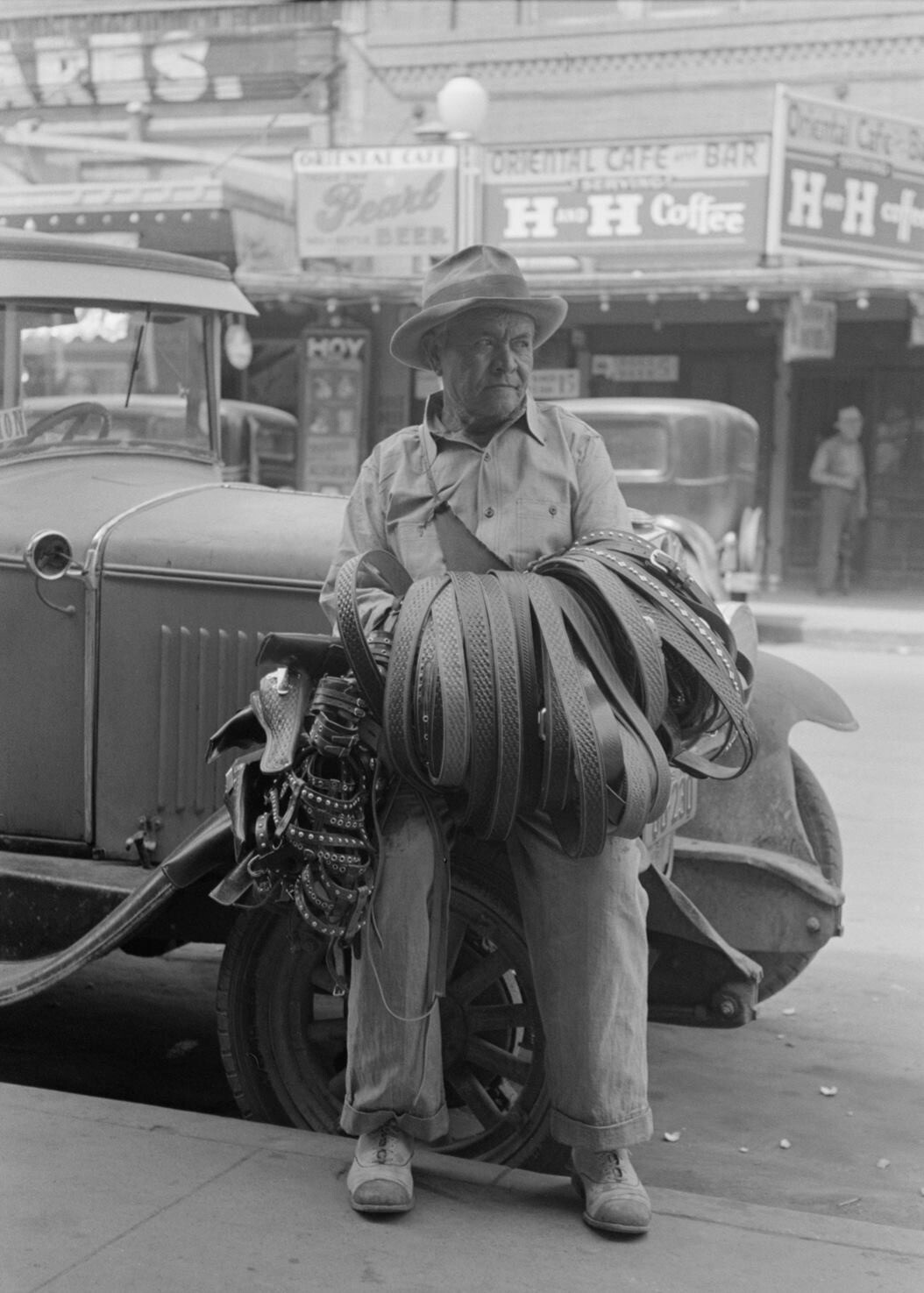
- Sign format: the Oriental Cafe frame shows a painted marquee/awning sign above a city cafe; this frame shows a portable porcelain-enamel rail-mounted sign on the porch of a country store. Between them we now have H&H documented in two distinct sign formats in two distinct retail environments of the same period.
- Market reach: the pair documents H and H Coffee’s distribution into both urban (downtown San Antonio) and rural (South Texas Tejano general-store) retail in the same era. For a firm whose Delaware Street plant was in San Antonio and whose delivery trucks are separately documented in the Reference gallery, this is a visible piece of commercial reach — Tejano rural stores were a real part of the customer base.
- Sign variant documentation: the museum collection already holds a cardboard H and H Coffee sign. This photograph documents the porcelain-enamel / painted-metal variant of the H&H Coffee storefront sign, in use, on a real porch. It complements the cardboard version as a different point-of-sale vehicle for the same brand identity.
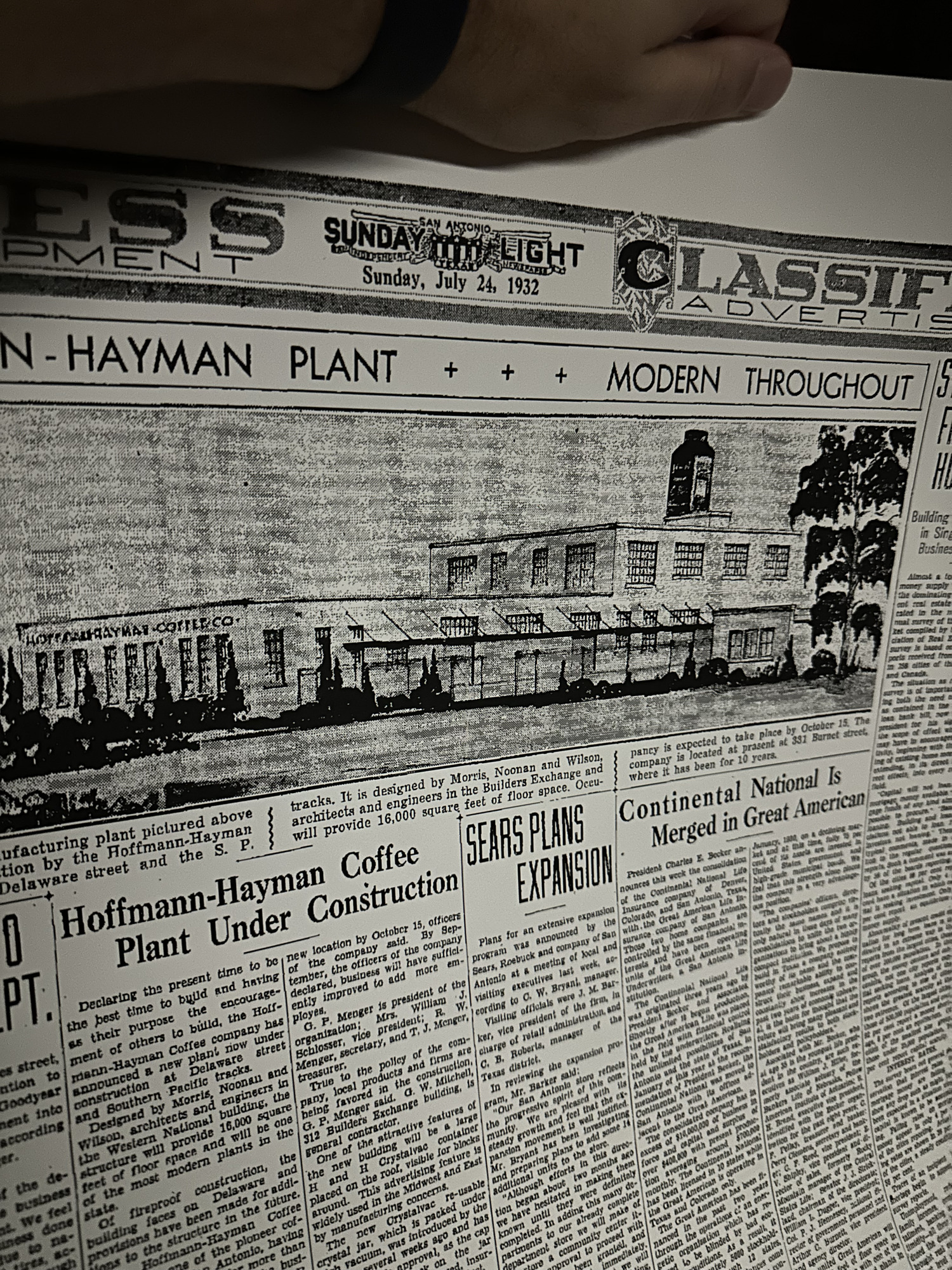
The frame also ties into the 1932 San Antonio Sunday Light factory announcement added to the Collection the week before this one: the 1932 article talks about the Delaware Street plant being built to serve San Antonio and the surrounding trade territory. Ten years later, this photograph shows exactly that trade territory — H&H Coffee branded and sold on the porch of a rural South Texas Tejano general store — in the same visual language FSA photographers used to document that whole Texas economy.
Open questions
- Attribution. Is this an FSA or OWI photograph (Library of Congress), a news photograph, or from another archive? The stylistic match is strong; the documentary match has not been confirmed from source. If you recognize the frame or know the photographer, the [contact page]({{ site.baseurl }}/contact/) is the right place.
- Location. The storefront is somewhere in a South Texas Tejano community; the specific town, store, and proprietor are not yet known.
- “ESPAUDA Health Club.” The first word on the Spanish-language window sign is hand-lettered and slightly uncertain; corrections welcome.
- The seated man. Unidentified; if this image turns out to be an FSA/OWI frame, a LOC caption may name him.