
Broncho Coffee began as a Morrison Coffee Company brand in San Antonio, named explicitly in the 28 January 1917 San Antonio Express Hoffmann-Hayman acquisition announcement as one of five Morrison brands H&H committed to continue packing (“‘WESCO,’ ‘MISA,’ ‘BRONCHO,’ ‘TEXCO’ and ‘JUANITA’”). Surviving Broncho packaging from after the February 1917 Morrison transfer carries Hoffmann-Hayman Coffee Co. markings — often on the side panel — while keeping Morrison-era trade dress such as the bucking-horse vignette and western lettering. The documented retail run on this site brackets 24 August 1912 (first attestation, Express-News sugar-and-coffee market quotation) through 28 November 1926 (San Antonio Light “Largest Coffee Plant” feature where BRONCHO is listed in the six-brand high-grade roster alongside H AND H BLEND, SAM HOUSTON, BORDER, MENGER PEABERRY, and TEXCO). The 19 August 1917 Express wholesale roster gives the documented retail formats explicitly: “Broncho in 1-lb. cans and 3½ and 4-lb. pails.” The canonical wordmark is Broncho (with H). Occasional “Bronco” spellings in newspapers and auction copy are editorial or third-party variants, not the firm’s chosen mark (see Canonical spelling).
After November 1926 Broncho drops out of the on-site primary record — absent from the 2 March 1942 wholesale price sheets and every 1957–1964 retail source (see Documented absence below). The brand’s exit window is 1926–1942, the same pattern documented for sibling brands Border (1926+), Sam Houston (1935+), and Anita (1942+) — the H&H mid-century brand-attrition cluster.
The site’s main write-up of the acquisition tin — with auction context, wire bail handle, and a full rotation of photographs — is the collection post Broncho Coffee tin, three-pound pail. The American Pickers connection (Mike Wolfe’s Texas gift tin in the show, plus the Art of the Pick book and signed Broncho print we purchased from Antique Archaeology / Art of the Pick) is summarized in Broncho Coffee & American Pickers.
Products
- One-pound tin
- Three-pound cylindrical package (tin / pail with wire bail handle)
Packaging
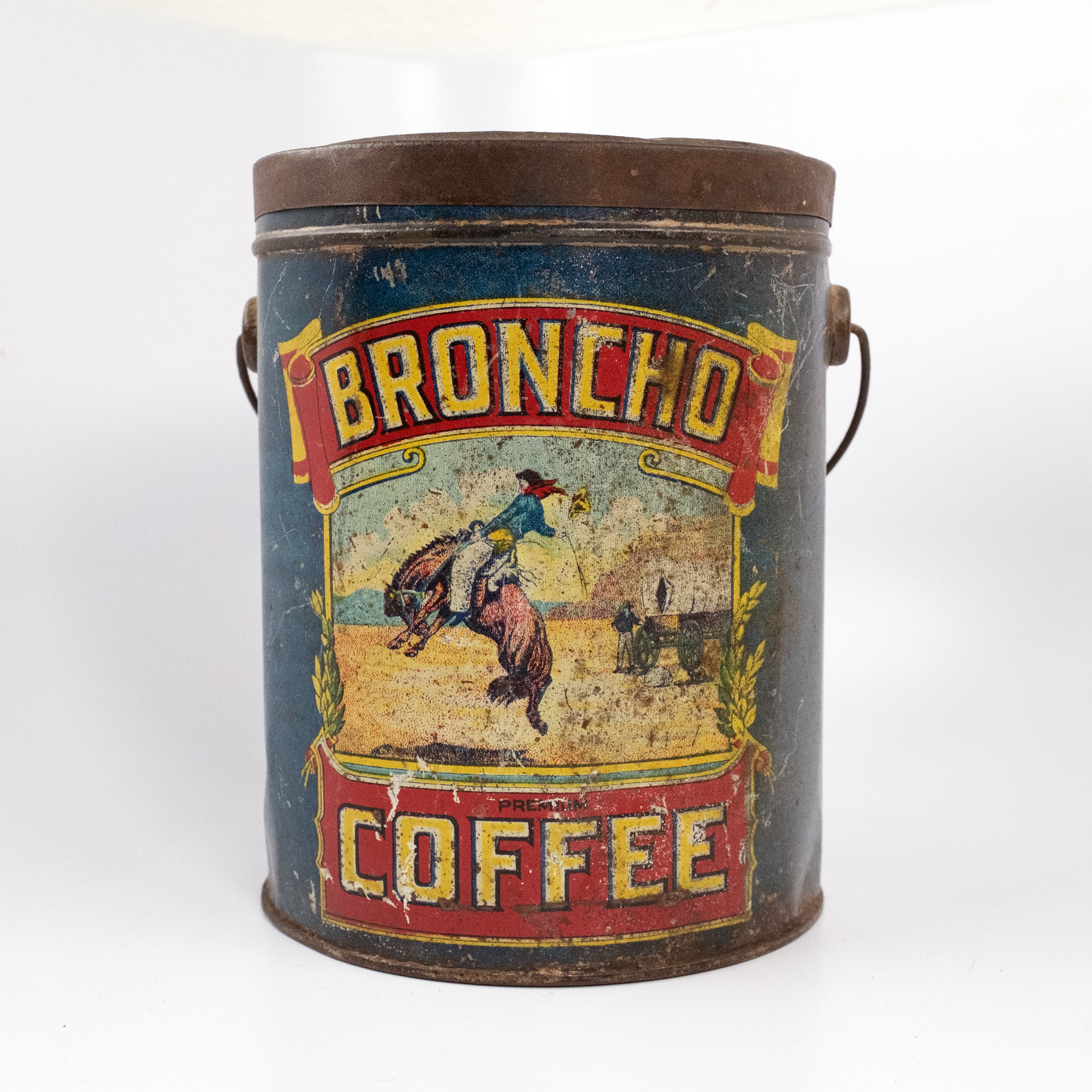
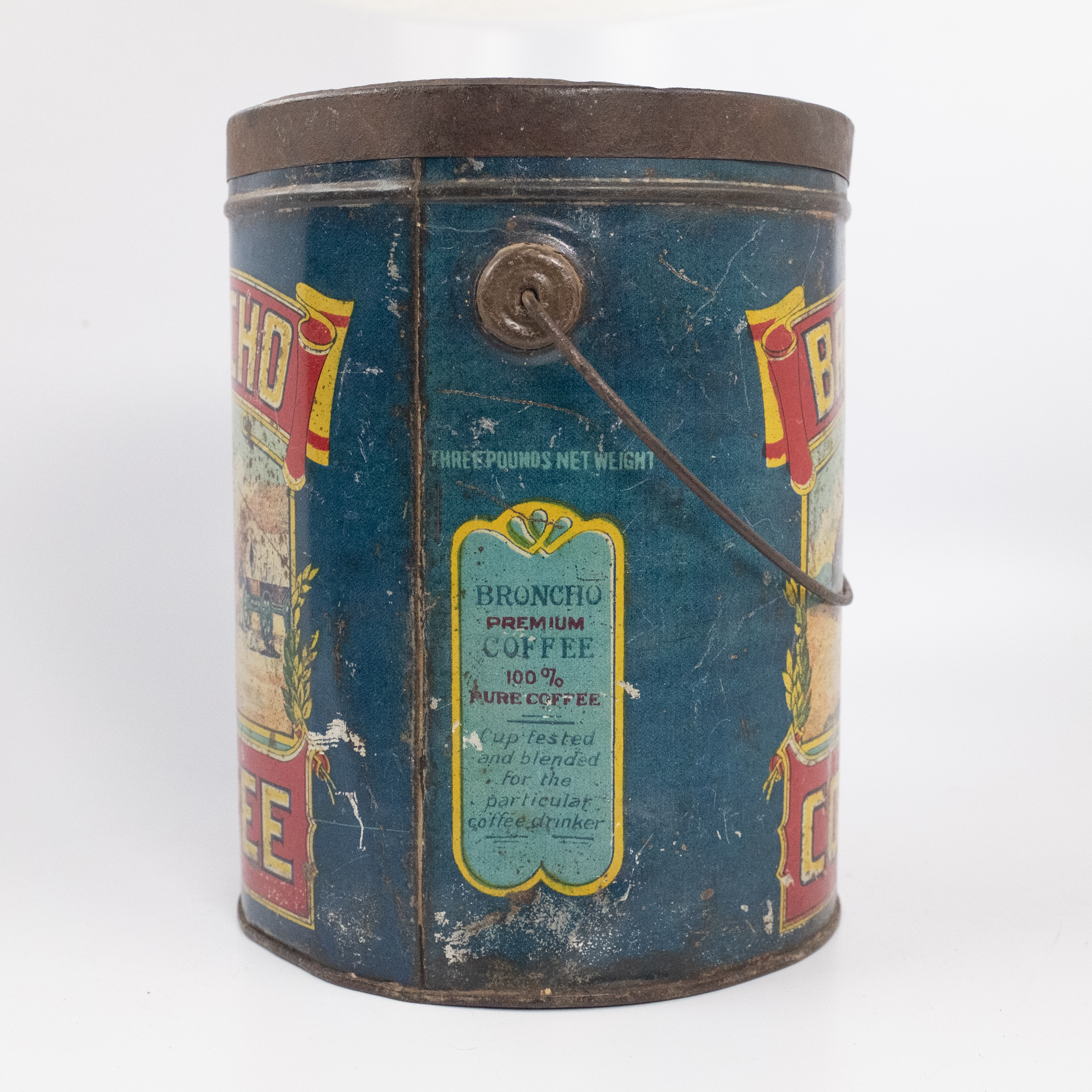
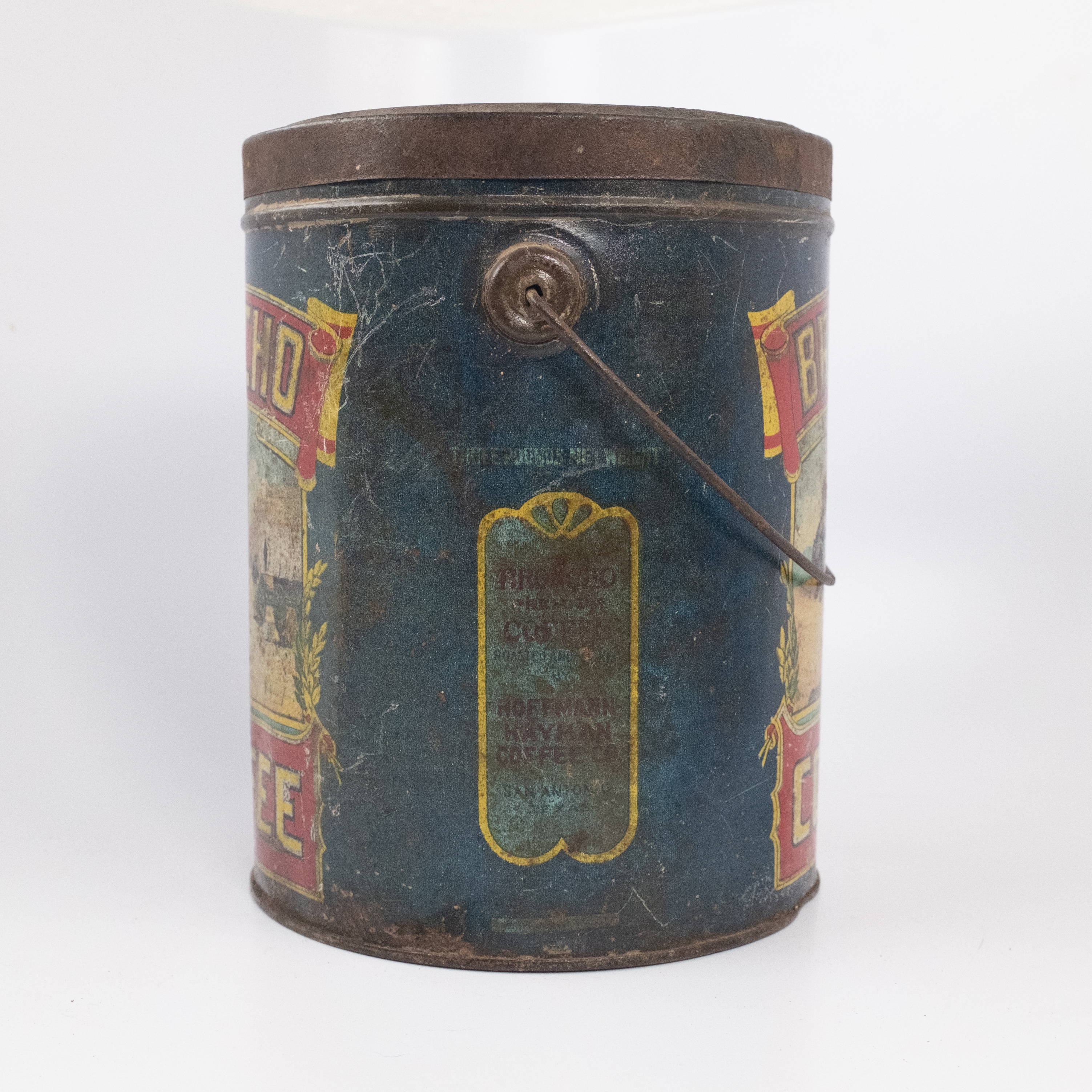
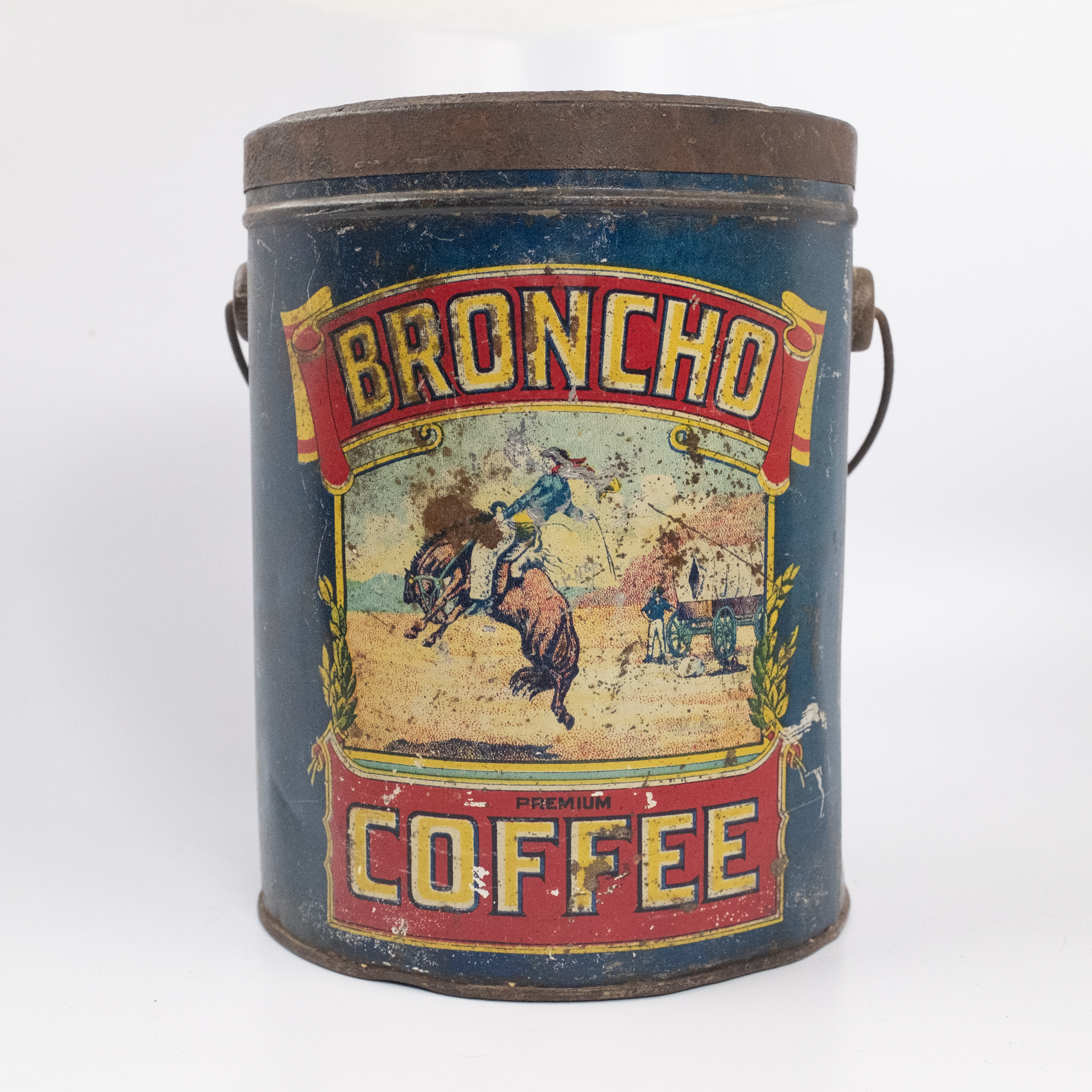
Three-pound Hoffmann-Hayman Broncho tin in the collection (front, sides, and back).
- Front
- Left
- Right
- Back
Ephemera
A postcard in the Sam Houston write-up shows H and H Blend, Sam Houston, Menger Peaberry, and Broncho together in one Hoffmann-Hayman layout—useful for seeing how the company merchandised the line. See Sam Houston Coffee label (image toward the end of that post).
Collection posts
- Broncho Coffee tin, three-pound pail — in-hand Hoffmann-Hayman pail, auction context, full rotation.
- Broncho Coffee & American Pickers — Art of the Pick book and signed print, advertising card with A Brand for Every Demand quartet (Blend, Sam Houston, Menger Peaberry, Broncho).
- Sam Houston Coffee label — postcard showing Broncho with Blend, Sam Houston, and Menger Peaberry.
Reference photography
Three-pound Broncho tin — listing photograph from ArtofthePick.com (Antique Archaeology / American Pickers context); the physical tin is not in Our Collection, but the project holds the poster of this art (see Reference and Broncho Coffee & American Pickers).
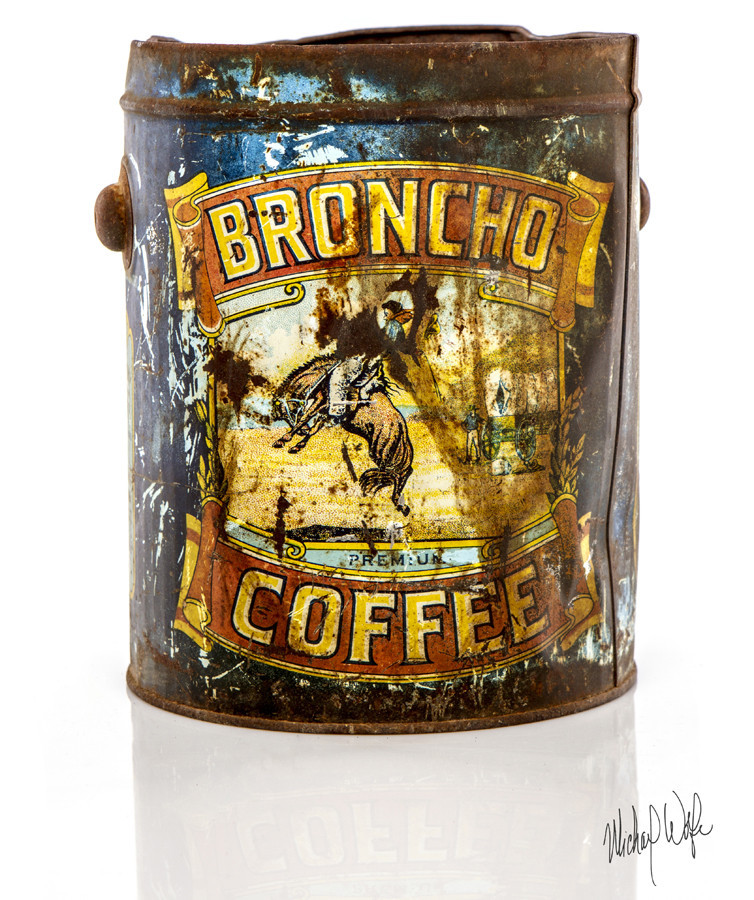
In-hand Hoffmann-Hayman photography appears under Packaging and Broncho Coffee tin, three-pound pail.
Newspaper & period branding
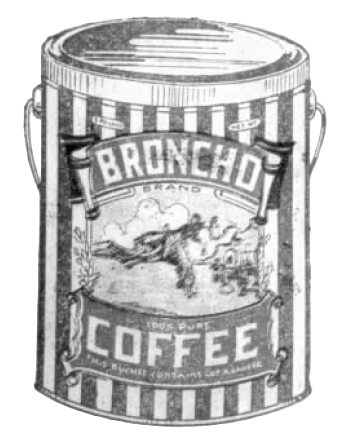
Isolated Broncho panel from the 26 Aug 1923 San Antonio Light housewife products spread (full page).
Related lines
- O.S.T. Old Spanish Trail Coffee — the H&H trademark for “O.S.T. Old Spanish Trail” (serial 261,672, granted June 1928) likely overlaps with or IS the Broncho identity. The 2 March 1942 wholesale price sheet lists “O.S.T. Fancy Santos Peaberry” as an active bulk line on the same sheet where Broncho is absent from retail SKUs — suggesting the O.S.T. name survived Broncho’s retail exit, possibly as a bulk/institutional designation for the same product family. See O.S.T. Old Spanish Trail Coffee for the trademark record and open questions.
- Border Coffee — pail-and-premium business model sibling. Both Border and Broncho carried in-package premium giveaways in the 1923 H&H products spread, both in three-pound lithographed pails: Border in a lithographed bucket with imported cup-and-saucer premium, Broncho in a lithographed pail with imported cup-and-saucer-with-gold-band-design premium. The matching three-pound pail format across both brands matches the museum’s surviving Broncho three-pound pail and the Witte’s surviving Border three- and four-pound premium pails. See Border Coffee § Pail-and-premium business model (1923) for the 3-brand comparison table (Border / Broncho / Spoon).
- Texco Coffee · Wesco Coffee · Misa Coffee · Juanita Coffee — the four other Morrison-acquired brands named in the 28 January 1917 acquisition announcement. Of the five, Texco persisted longest (into the 1942 wholesale price sheets); Wesco, Misa, Broncho, and Juanita all drop out of the documented record by 1942.
- H and H Blend Coffee · Sam Houston Coffee — frequent 1930s co-advertising; the H&H “Brand for Every Demand” quartet pairs Broncho with H and H Blend, Sam Houston, and Menger Peaberry on the surviving advertising postcard.
- Menger Peaberry Coffee — shares the postcard quartet layout with Broncho; both appear in the 1923 Light products spread and the 1926 Largest Coffee Plant roster.
- Anita Coffee — sibling brand with parallel post-1926 / post-1942 documentary silence; together with Border, Broncho, Sam Houston, and Anita, the four trace the H&H mid-century brand-attrition pattern that left H and H Coffee, Master Chef, Master Chef Instant, and Texas Girl as the surviving 1960 corporate-roster wordmarks.
- Morrison Coffee Company — predecessor firm; Broncho was among the five brands H&H committed to continue in the 28 Jan 1917 acquisition notice.
- Hoffmann-Hayman Coffee Company — corporate hub.
- H and H Product Line — product-family index.
Documented absence after 1926
The brand drops out of the on-site primary record after the 28 November 1926 San Antonio Light “Largest Coffee Plant” feature. The pattern mirrors Border (1926+ retirement window) and is part of the mid-century H&H brand-attrition cluster.
- 2 March 1942 H&H wholesale package and bulk price sheet (“FOR TEXAS ONLY”) — package SKUs: H AND H, SAN ANTONIO, TEXAS GIRL, ANITA, TEXCO, BIG VALUE, M. CHEF. Bulk lines: Economy Blend Cereal and Coffee, Good Rio, Big Gum, Arrow Peaberry, Standard Peaberry, Perfection Peaberry, Blue Bird, Anita Peaberry Blend, Good Value, O.S.T. Fancy Santos Peaberry. No Broncho in either tier.
- 23 December 1942 – 23 July 1943 Flav-O-Tainer ad campaign — H&H Drip Grind wartime cellophane-bag ads. No Broncho.
- 7 November 1957 San Antonio Express Master Chef Instant Coffee launch. No Broncho.
- 20 February 1959 Valley Morning Star (Harlingen) p. 20 Burpee Flower Garden coupon (accepts H AND H or Texas Girl Coffees; Master Chef strip; Master Chef Instant label). No Broncho.
- 5 May 1960 San Antonio Express-News — Albert Menger president corporate product roster (“Master Chef Coffee, Master Chef Instant Coffee, H and H Coffee, Texas Girl Coffee and other consumer and [institutional] coffee”). No Broncho (could be inside the “other consumer … coffee” residual but not named).
- 27 May 1964 Fredericksburg Standard p. 3 grocery price block. No Broncho.
Broncho’s exit window is therefore between November 1926 and March 1942 — a 16-year retirement gap in the on-site record, the same shape as Border. Of the five Morrison-acquired brands named in the 28 Jan 1917 acquisition announcement, only Texco survived into the 1942 wholesale sheets; Wesco, Misa, Broncho, and Juanita all drop out of the documented retail record by 1942.
Canonical spelling (resolved)
Status: Resolved — Broncho is the firm’s primary wordmark; Bronco without H appears only as newspaper or third-party editorial variation.
| Evidence | Spelling | Notes |
|---|---|---|
| 24 Aug 1912 Express-News market column (HH-CLIP-1912-0003) | Broncho | Morrison-era wholesale price card — first on-site attestation |
| 28 Jan 1917 Morrison acquisition notice | BRONCHO | All-caps in the five-brand roster (HH-BRNG-1917-0004) |
| Hoffmann-Hayman three-pound tin (collection + reference photography) | BRONCHO | Lithographed cartouche on face and banding (tin rotation; HH-REF-0000-0029) |
| Factory sales forms (SHOW ITEMS SOLD) | Broncho | Preprinted line on interwar order books (HH-COLL-0000-0020) |
| 27 Jul 1924 Trade Week feature | Broncho / Bronco | House copy uses Broncho; the same page spells “Bronco” in places — typesetter drift, not packaging authority (HH-CLIP-1924-0009) |
| Lebel auction lot 358 catalog (2023) | Broncho / Bronco | Lot title URL says bronco-coffee-tin; catalog prose reads Broncho coffee (HH-COLL-0000-0034) |
No Morrison-era Broncho trademark filing has been located in this archive; the 1912 market clip, 1917 acquisition notice, factory forms, and tin lithography are sufficient to close the spelling question. The site standardizes on Broncho in all H&H/Morrison contexts.
Cultural context — the “Broncho” spelling
The brand name uses the Broncho spelling (with H), the same form used by Frederic Remington for his defining 1895 sculpture “The Broncho Buster” (Roman Bronze Works, cast 1909; Smithsonian American Art Museum, accession 2005.23.2 — SAAM). Remington’s work had appeared in the White House Oval Office across multiple presidential terms by the time Morrison Coffee Company coined the brand; the “Broncho” spelling with H was the prestige / period form of the word in that era.
The SAAM entry on the sculpture notes that the original bronco busters were Mexican vaqueros — with mixed European, Indigenous, and African heritage — a fact that grounds the word in its Spanish origin. A Heritage Auctions reference photograph of the sculpture appears in the site post Remington’s Broncho Buster and the H&H brand spelling. San Antonio, where H&H operated, was a city with deep Tejano culture; the Spanish-root word bronco (rough, wild, unbroken) would have carried both cowboy-English meaning and Spanish resonance for local consumers simultaneously. The brand name works in both languages at once.
Open questions
- Why did Broncho disappear by 1942 while Morrison-sibling Texco survived? Both Morrison-acquired brands appear in the 1917 acquisition announcement; both appear in the 1923 products spread and the 1926 Largest Coffee Plant roster; but Texco persists into the 1942 wholesale price sheet (and the 1923 products spread sized it as a “one-pound double-fluted bag” — a smaller-format retail line) while Broncho (sold in three-pound lithographed pails with imported cup-and-saucer-with-gold-band-design premium) does not. Did the premium-pail-with-giveaway business model become uneconomic during the Depression and wartime rationing, while the smaller-format Texco persisted as a value-tier alternative? A 1927–1941 H&H price sheet or jobber’s catalog tracking the premium-pail line specifically would help discriminate.
- What was the relationship between Broncho’s bucking-horse vignette and the Western-named H&H sibling brands? Anita’s Witte-Museum reference pail carries “Star of the Ranch” Western imagery; Sam Houston is a Texas-hero brand. Were Broncho, Anita, and Sam Houston a coordinated Western-trade-dress family within H&H’s portfolio, distinct from the Spanish-name (Misa, Juanita, Texco) and house-name (H and H Blend, H and H Coffee) wordmark families?
Wanted
- Broncho Coffee one-pound tin — documented in the 4 May 1915 Express-News wholesale market column (“Broncho, 1-pound cans, 24c”), still sought as a surviving artifact
- A clear example of a four-pound Broncho premium pail — documented in the same 1915 column (“Broncho, 4 pounds, with premium, 85c”) and the closest pre-acquisition match to the three-pound lithographed premium pail in the 1923 Light ad; the museum holds a three-pound tin but no four-pound or one-pound surviving Broncho
- Newspaper or broadside advertisements, factory photos, or sales paperwork naming Broncho that are not already represented on the site
(Note: PDF verification of the 26 August 1923 San Antonio Light “H AND H Products” ad on 2026-05-16 corrected the 1923 spread’s Broncho format from a prior on-site rendering of “one-pound canister” to three-pound lithographed pail — the same size already in the museum collection. The 1-lb Broncho Wanted line above traces specifically to the 1915 wholesale market column, not to the 1923 ad.)
See also
- Morrison Coffee Company — predecessor; BRONCHO named in the 28 Jan 1917 acquisition roster
- Hoffmann-Hayman Coffee Company — corporate hub; 1924 Trade Week feature (editorial Bronco drift on the same page)
- Mystery § Resolved chapters — Broncho spelling closed 2026-05-25
- Frederic Remington Broncho Buster reference (HH-REF-0000-0248) — prestige-period Broncho spelling parallel to the coffee wordmark
- O.S.T. Old Spanish Trail Coffee
- Hoffmann-Hayman acquires Morrison Coffee Co.