
Sam Houston Coffee is a Hoffmann-Hayman retail line — named for the Texas hero portrait on the label — documented continuously in San Antonio press and retail collection objects from November 1926 through April 1935, then absent from the on-site primary record afterward. The earliest attestation is the 28 November 1926 San Antonio Light “Largest Coffee Plant” ad (post) where Sam Houston is listed in the high-grade roster (“Roasters and Blenders of the Following High Grade Coffees: H AND H BLEND, SAM HOUSTON, BRONCHO, BORDER, MENGER PEABERRY, TEXCO — And Various Other Brands”). Sam Houston is a Hoffmann-Hayman creation — not Morrison-acquired (no [^1] footnote on the Brands index) — and was sold alongside H and H Blend, Texas Girl, and other house marks throughout its documented run. Ads often pitched Perc-O-Drip grind for percolators and drip pots, and Sam Houston shows up on sales forms, napkins, and newspaper display pages with the same graphic vocabulary as the one-pound tins.
After April 1935 Sam Houston drops out of the documented primary record on this site. The 2 March 1942 H&H wholesale package price sheet names H AND H, SAN ANTONIO, TEXAS GIRL, ANITA, TEXCO, BIG VALUE, and M. CHEF as the retail-package SKUs — no Sam Houston. The 5 May 1960 San Antonio Express-News corporate product roster (“Master Chef Coffee, Master Chef Instant Coffee, H and H Coffee, Texas Girl Coffee and other consumer and … coffee”) similarly doesn’t name Sam Houston. Period framing tightens to 1926–1935 (documented retail run) with the recognition that the post-1935 silence may indicate retirement, rebranding (possibly absorbed into the “H and H Coffee” umbrella that emerged in the same window), or a transition to an institutional-only line not surfacing in retail ads — see Open questions below.
Products
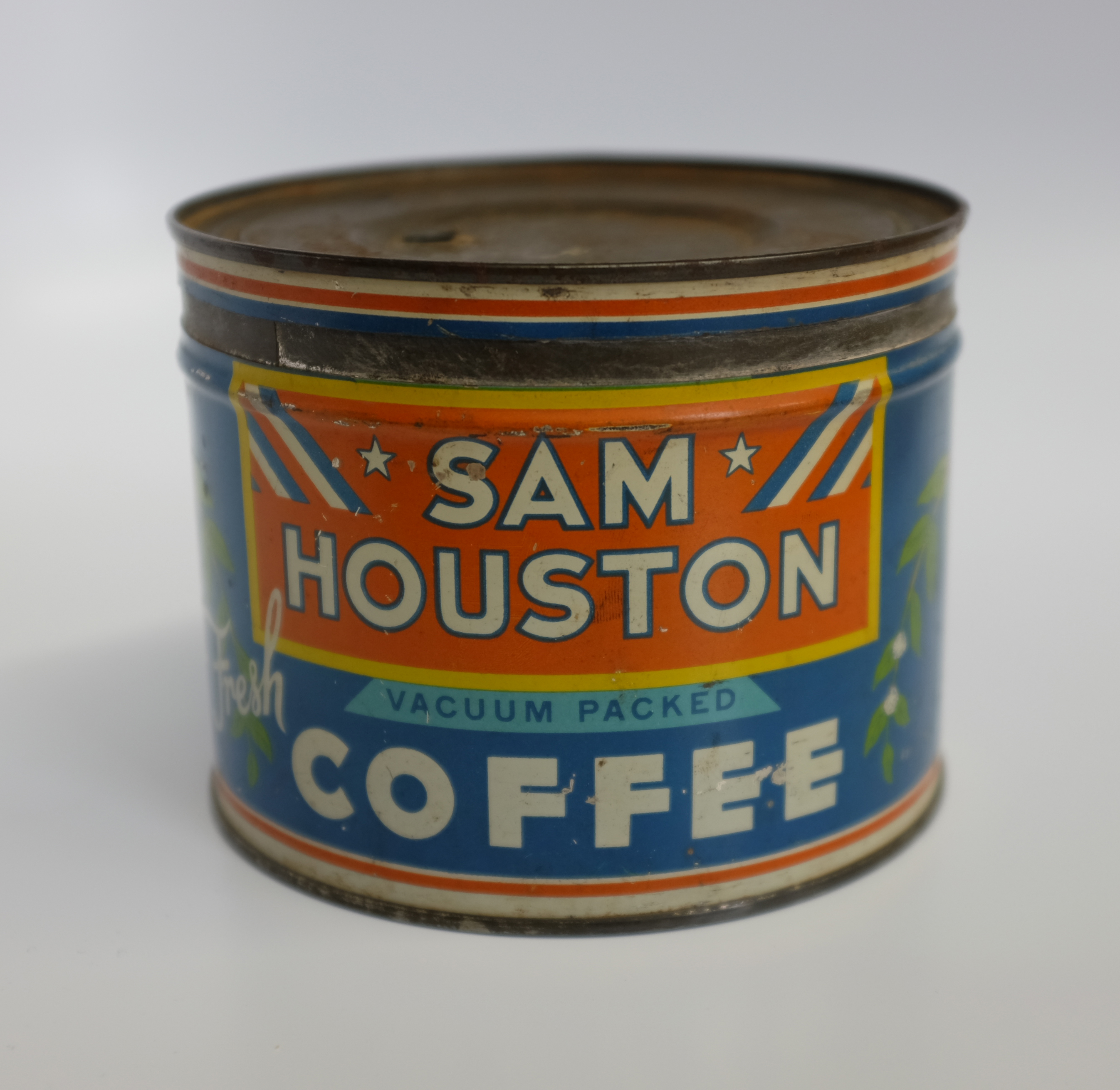
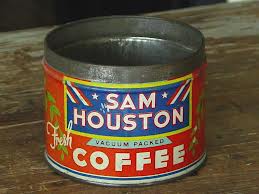
- Sam Houston Coffee — one-pound keywind or flat-top tin (retail example from 2019 in the collection); confirmed in Sep 1929 ad (free water-tumbler premium) and Jun 1930 $1,000 Label Contest (½ lb and 1 lb sizes named)
- Sam Houston Coffee — ½ pound — confirmed in 12 June 1930 The News $1,000 Label Contest; ½ lb listed as an enterable container size
- Sam Houston Coffee — 3 pound — confirmed in Sep 1929 ad (free cup & saucer premium in every 3-lb can)
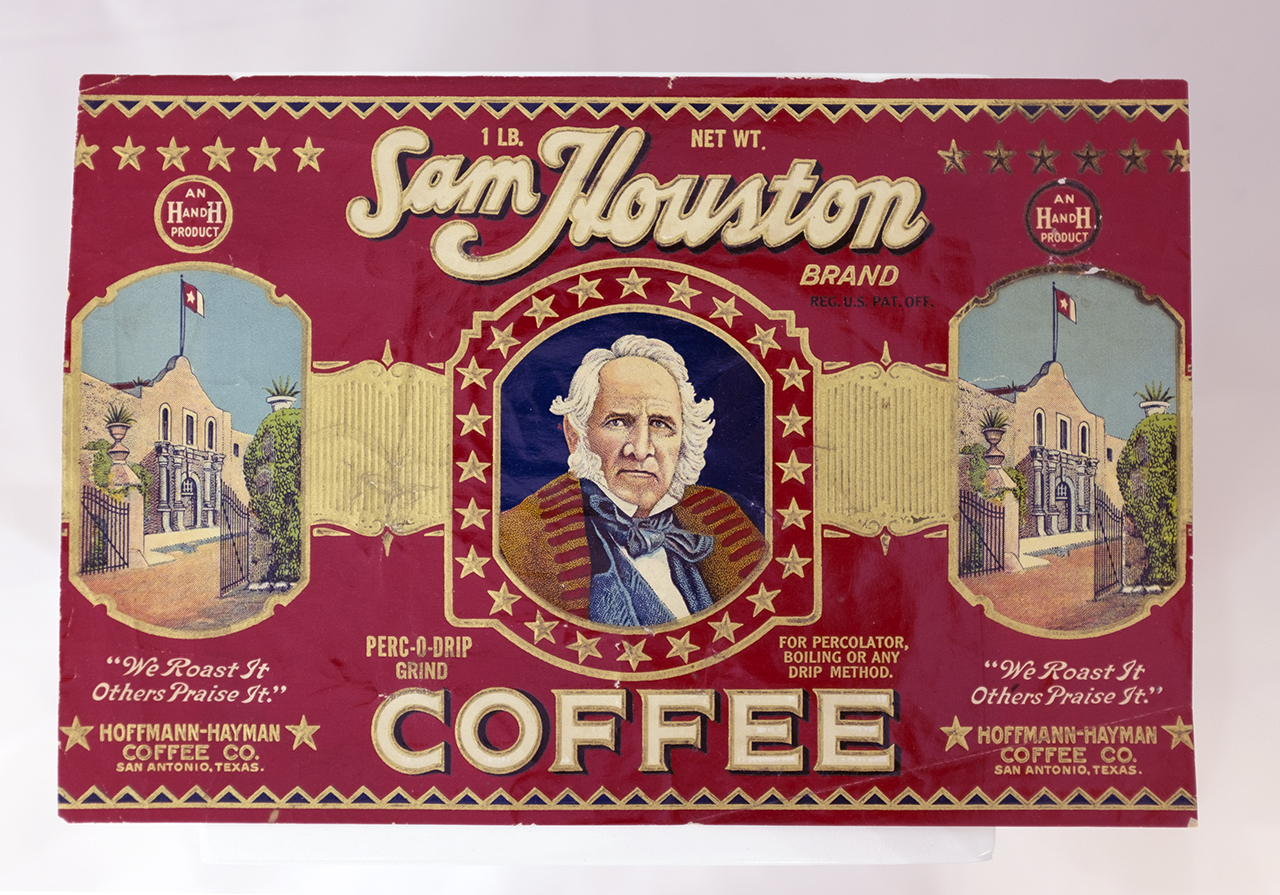
- Mid-size tin — a paper label in the collection was peeled from a bigger Sam Houston can than one pound (see Sam Houston Coffee label).
- Large tin — the 10 March 1934 The News product display (post) shows 3 Sam Houston cans of graduated size matching the same 3 sizes shown for H and H Blend — confirming shared can formats across both brands in March 1934. No labeled specimen for the mid or large size.
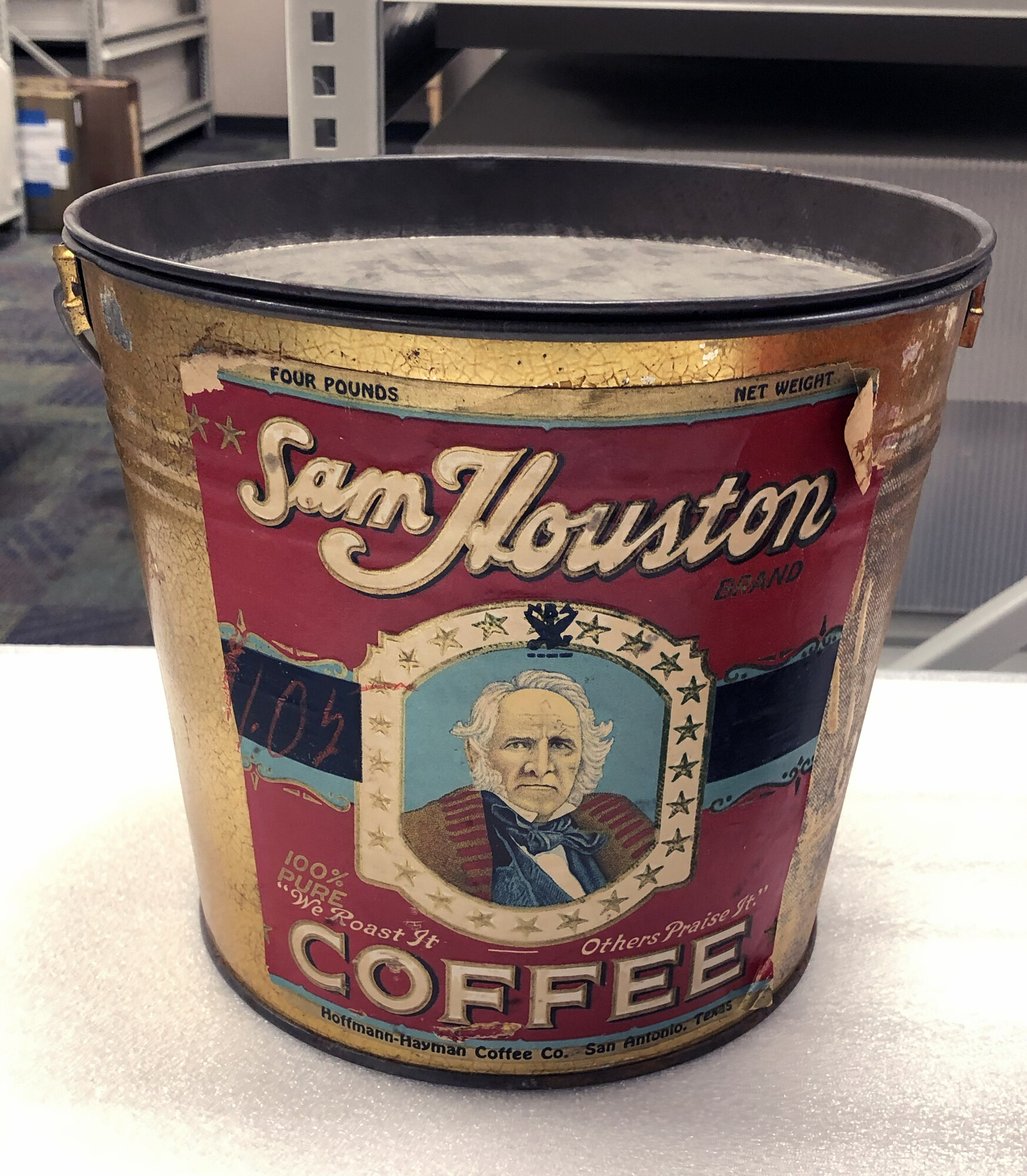
- 4 lb wire-bail pail — Witte Museum reference example. The March 1934 display (a grocery-store promotion) shows only cans, not pails, suggesting pails served a wholesale/institutional channel (restaurants, hotels, lunch counters) distinct from grocery retail. Research needed: wholesale price sheets, hotel supply catalogs, or foodservice invoices naming Sam Houston pails. See also Texas Girl Coffee for the parallel 4 lb pail pattern.
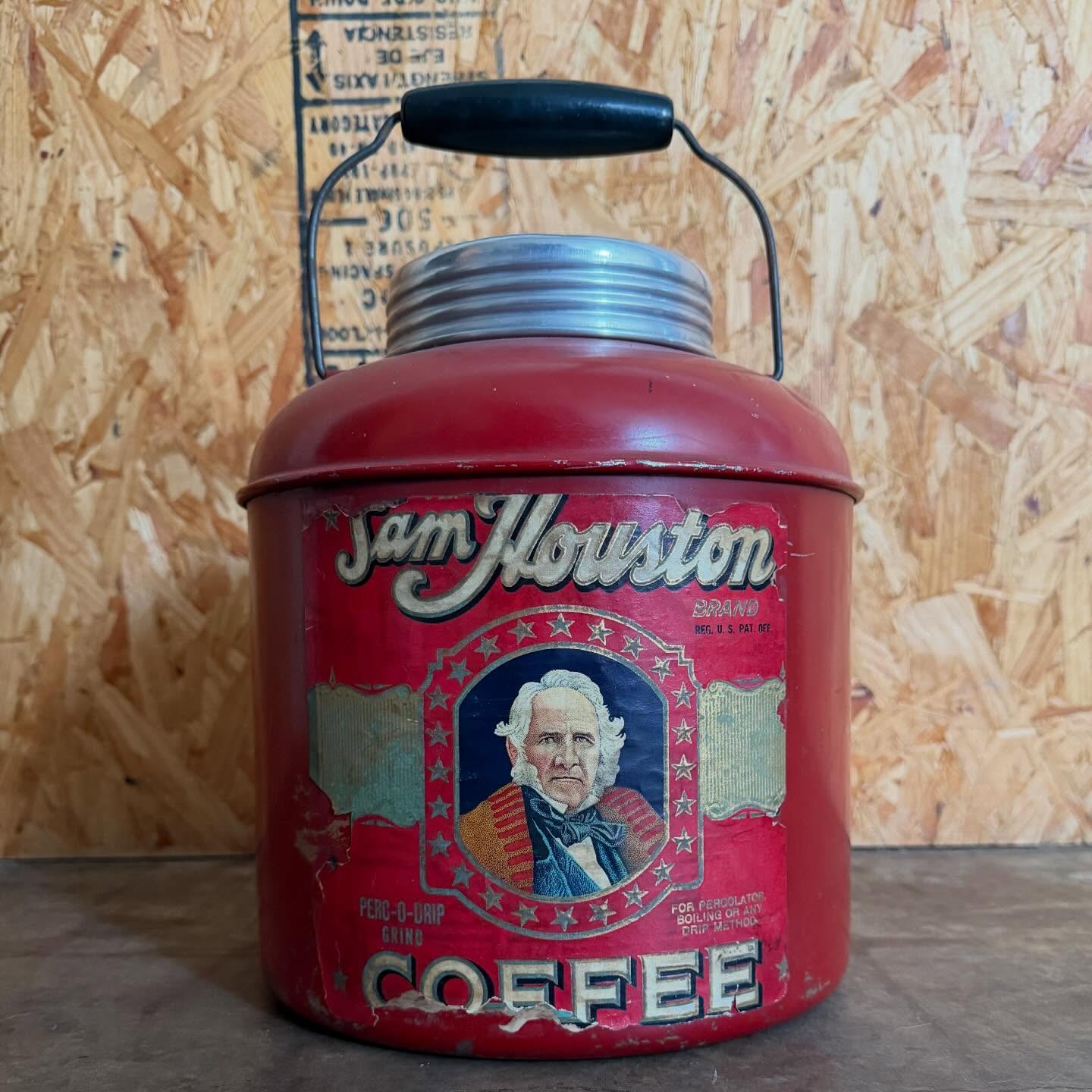
- Insulated jug / serving carafe — Sam Houston Coffee insulated jug (branded Perc-O-Drip artwork matching the label line).
- Counter ephemera — H and H napkin — Sam Houston & Texas Girl
Options
- Drip grind
- Regular grind
- Pulverized grind
- Fine grind for glass brewers (blue sticker)
Packaging
Hero retail pieces; full rotation of the 2019 tin is in H and H Sam Houston tin.
- One-pound tin (Haysville, Kansas acquisition)
- Paper label (Perc-O-Drip grind, saved from a tin)
- Alternate one-pound face (also indexed in Reference)
- Insulated jug
Reference photography
Witte Museum — four-pound Sam Houston pail photographed 15 October 2019 during the Witte visit (institutional reference, not in Our Collection; see Reference).
Advertising
September 1929 — free premium program (water tumbler and cup & saucer)
The News (San Antonio), Tuesday, 24 September 1929, p.54: Sam Houston Coffee ran a free-premium program — “FREE PREMIUMS” — included with every can:
- Water Tumbler free in every 1-pound can
- Cup and Saucer free in every 3-pound can
Headline description: “The best Premium Coffee on the Market.” The ad shows the Sam Houston Coffee tin with the portrait label clearly visible. This is the earliest premium-program attestation for Sam Houston; it predates the brand’s Crystalvac-jar era by six years, and establishes the 1-lb and 3-lb can sizes as the two principal retail sizes in 1929. A companion ad on the same page (The News, Sep 24, 1929, p.54) for H and H Blend Coffee claimed 60% of San Antonio’s high-grade coffee drinkers demanded H and H — the Sam Houston premium program appears to have been the differentiation strategy for the secondary brand.
Notable contrast with H and H Blend’s contemporaneous advertising posture: a June 1920 The News ad for H and H Blend explicitly announced “No premiums with H.&H. coffee — your money’s worth of pure 100 per cent coffee”, pitching quality over premiums. The Sam Houston premium program ran under the same company on a parallel brand, suggesting H&H deliberately segmented premium strategy by brand. Source: Raw Sources Registry.
November 1926 — first documented attestation (Largest Coffee Plant)
The 28 November 1926 San Antonio Light “Largest Coffee Plant” full-page ad (post) is the earliest on-site primary source naming Sam Houston Coffee. The Hoffmann-Hayman header copy reads “Roasters and Blenders of the Following High Grade Coffees: H AND H BLEND, SAM HOUSTON, BRONCHO, BORDER, MENGER PEABERRY, TEXCO — And Various Other Brands.” This places Sam Houston in the six-brand high-grade tier of mid-1920s H&H retail, alongside the H and H Blend flagship, the Morrison-acquired Broncho and Texco lines, and the Border and Menger Peaberry house brands. Sam Houston is not in the 1917 H&H wholesale roster (which lists nine packages: Wesco, H. & H., Texco, Double H, Border, Broncho, Juanita, Big Dime, Fancy Peaberry) — so the brand was introduced sometime between 1917 and November 1926.
December 1932 — Crystalvac capability (forward-looking)
The 21 December 1932 Express-News “Southwest finest plant — coffee you praise” plant-opening copy (post) describes the new 601 Delaware Street facility as having “the most modern facilities for vacuum packing H and H and Sam Houston Coffee in the revolutionary new H and H Crystalvac container.” This is plant-capability copy, not a retail launch — it states that the new plant can pack Sam Houston in Crystalvac, but the explicit Sam Houston Crystalvac retail launch came two-plus years later (next section). The display panel “A Brand For Every Demand” on the same page does illustrate Sam Houston among packaged brands, alongside Master Chef, H and H Blend Crystalvac, Menger Peaberry, H and H tea, and H and H vanilla extract — establishing Sam Houston as part of the December 1932 plant-opening showpiece roster.
March 1935 — Sam Houston Crystalvac retail launch
The Sam Houston Crystalvac retail launch is announced in The News (San Antonio), Saturday, 9 March 1935: “Sam Houston Coffee Now Offered in Crystalvac Jars at Low Popular Price.” The piece reports that the Hoffmann-Hayman Coffee Co. introduced Sam Houston Coffee in vacuum-packed Crystalvac jars “during the last week” (so launched ~March 1935), positions the brand as “San Antonio’s greatest coffee value” at a retail price of 25 cents per pound, and details a jar-return economy:
- Jar deposit: 3 cents per returned one-pound Crystalvac jar (refundable at grocers or directly at the plant)
- “H & H Flyer” box-kite premium: one kite given for three returned one-pound jars
- Company spokesperson quoted: R. W. Menger (then secretary-treasurer)
The same article notes “Texas Girl Brand in New Baby Package” — a separate Texas Girl repackaging launched in the same window (see Texas Girl Coffee).
Address note. The 1935 OCR’d transcription gives the H-H plant address as “693 Delaware Street.” This is a typesetter / OCR error: the canonical and otherwise universally-attested address is 601 Delaware Street (confirmed by the 1932 plant-opening press coverage and the 1939 building-permit notice). Treat the 1935 reference as “601 Delaware” in citation.
Brownsville Herald, April 1935
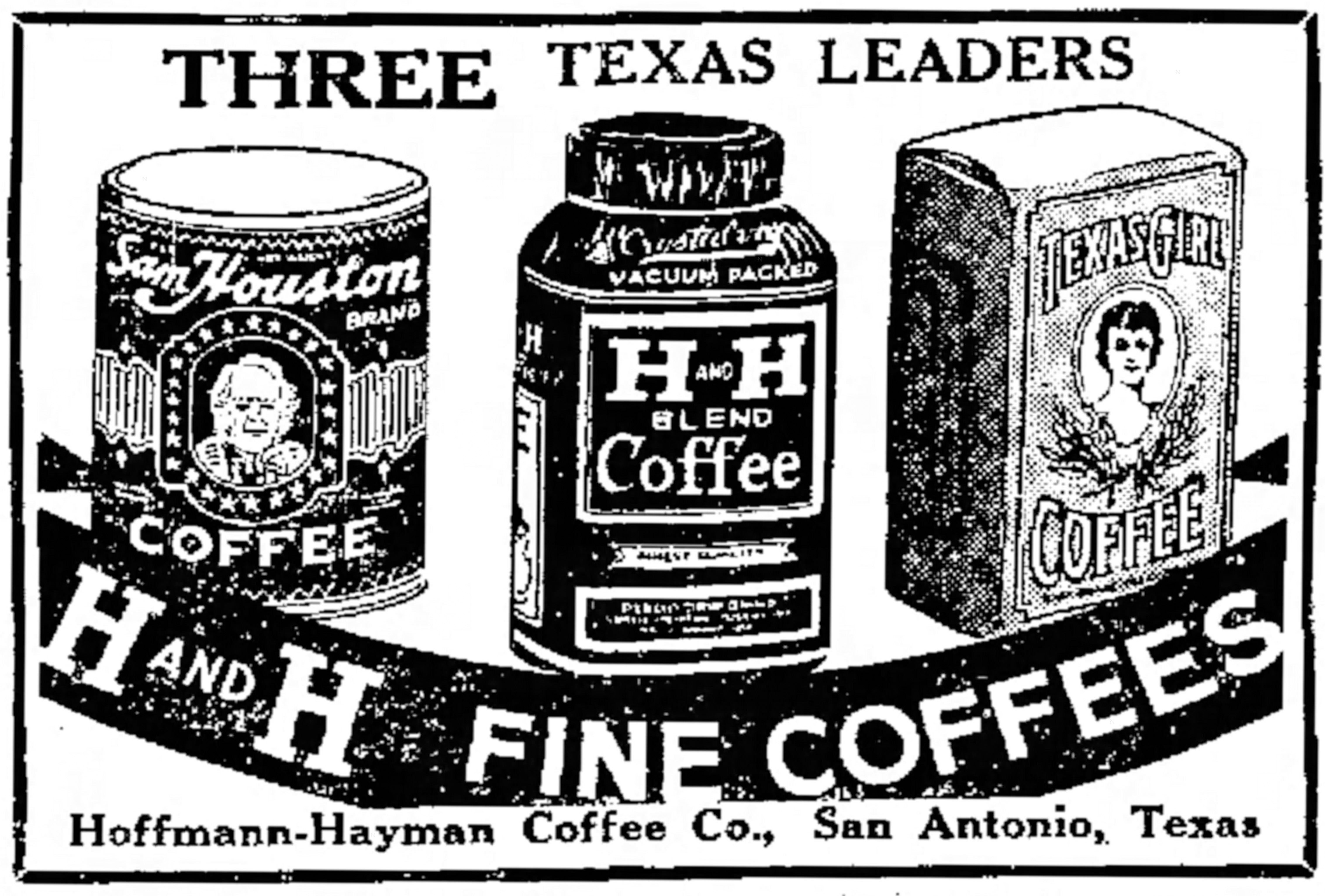
Brownsville Herald, Tuesday, April 16, 1935 — display ad with Sam Houston, H and H Blend, and Texas Girl (full page in Sam Houston Coffee label). More clippings live under Newspaper ads.
Postcard layout
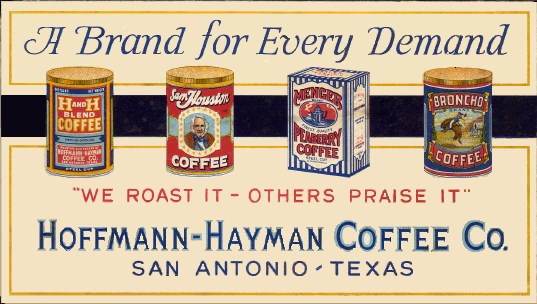
Hoffmann-Hayman postcard showing Blend, Sam Houston, Menger Peaberry, and Broncho — same asset used on Broncho and Menger Peaberry for cross-brand context.
Collection posts
- Sam Houston Coffee label — label, Brownsville ad, postcard.
- H and H Sam Houston tin — one-pound tin front, sides, lid, base.
- Sam Houston Coffee insulated jug — serving-ware scale.
- Sam Houston galvanized pail — Reference gallery documents Mac Johanson and Witte Museum examples; a museum pail post is not live yet (pending in-hand photography).
- H and H coffee napkin — Sam Houston & Texas Girl corner vignettes.
Factory sales forms listing Sam Houston among other lines: Sales forms.
Newspaper & period branding
Examples under Advertising and Collection posts; indexes: Newspaper ads · Branding in Newspapers.
Related lines
- Texas Girl Coffee · H and H Blend Coffee — frequent co-stars in 1930s advertising; Texas Girl survived to the 1960 corporate roster where Sam Houston did not.
- Menger Peaberry Coffee · Broncho Coffee — postcard quartet; both also named in the 1926 Largest Coffee Plant high-grade roster alongside Sam Houston.
- Crystalvac Jars — Sam Houston was the second brand into Crystalvac after H and H Blend; the 1935 launch announcement (with the 3¢ jar-deposit + H & H Flyer kite premium economy) is the model for how Crystalvac packaging extended beyond the flagship Blend line.
- Texco Coffee — Morrison-acquired sibling in the 1926 high-grade roster; the only Morrison-five brand that persisted into the 1942 wholesale price sheet where Sam Houston didn’t.
- Border Coffee — 1926 high-grade roster sibling with parallel post-1926 silence (Border last attested 1926; absent from both 1942 sheets, matching the same 1926→1942 retirement gap as Sam Houston’s 1935→1942 window).
- Hoffmann-Hayman Coffee Company — corporate hub.
- H and H Product Line — product-family index.
Continued retail attestation 1936-1938
Newspaper-body extraction surfaced four mid-period attestations that extend the documented retail run from April 1935 to July 1938:
- 13 April 1936 San Antonio Express-News — “the Hoffmann-Hayman Coffee Company’s new policy of making their three popular brands of coffee, H & H, Sam Houston and Texas Girl, also available in a FINE GRIND especially adaptable for use in glass coffee brewers” + Crystalvac jar coupon promo for Cory Improved Brewer.
- 17 July 1936 San Antonio Register — free packet of Staffel’s Blue Bonnet seeds “with each purchase of H & H, Sam Houston or Texas Girl coffee” — “three popular coffees” sponsored by H&H to perpetuate the Blue Bonnet species.
- 3 November 1937 The News — vacuum-can installation feature; brands listed as “H and H (leader); Texas Girl; Sam Houston (premium).”
- 7 July 1938 Brownsville Herald — grocer price line: “SAM HOUSTON COFFEE Pound 22¢” alongside “H & H COFFEE Pound 26¢”; free glass with each pound. Sam Houston is the value-tier sibling to H&H Coffee — priced 4¢/lb below.
- 16 July 1938 The News — “QUALITY H AND H PRODUCTS” three-panel display: Sam Houston at left, H and H High Grade vacuum-pack can at center, Texas Girl at right; footer “FOR EVERY TASTE and POCKETBOOK!”
Notable mid-1937 mixed signal: the 21 Nov 1937 San Antonio Light “Plant output is increased” article (Gus P. Menger quote, capacity-improvement focus) names “H and H San Antonio and Texas Girl coffees” and omits Sam Houston. Eighteen days earlier the same month’s News trade-feature names Sam Houston as “premium.” The Light omission is most likely a flagship-focused mention rather than retirement, given the July 1938 attestations.
Documented absence after July 1938
The brand drops out of the on-site primary record after 16 July 1938:
- 2 March 1942 H&H wholesale package and bulk price sheets (“FOR TEXAS ONLY”) — package SKUs: H AND H, SAN ANTONIO, TEXAS GIRL, ANITA, TEXCO, BIG VALUE, M. CHEF. Bulk lines: Economy Blend Cereal and Coffee, Good Rio, Big Gum, Arrow Peaberry, Standard Peaberry, Perfection Peaberry, Blue Bird, Anita Peaberry Blend, Good Value, O.S.T. Fancy Santos Peaberry. No Sam Houston in either tier.
- 23 December 1942 – 23 July 1943 Flav-O-Tainer ad campaign — three full-page wartime ads for H&H Drip Grind in cellophane-lined paper bag packaging. No Sam Houston.
- 7 November 1957 San Antonio Express Master Chef Instant Coffee launch. No Sam Houston.
- 20 February 1959 Valley Morning Star — Harlingen p. 20 Burpee Flower Garden coupon (accepts H and H, Texas Girl, Master Chef, Master Chef Instant). No Sam Houston.
- 5 May 1960 San Antonio Express-News — Albert Menger president corporate product roster: “Master Chef Coffee, Master Chef Instant Coffee, H and H Coffee, Texas Girl Coffee and other consumer and [institutional] coffee.” No Sam Houston (could be inside the “other consumer … coffee” residual but not named).
- 27 May 1964 Fredericksburg Standard p. 3 grocery price block (H and H Coffee 1-lb bag 59¢, Maryland Club Instant 10-oz $1.39, Tide king-size 99¢). No Sam Houston.
Sam Houston’s exit window is therefore between 16 July 1938 and 2 March 1942 — a ~3.5-year retirement gap in the on-site record (narrowed from the prior 7-year framing 1935→1942 by the 1936-1938 attestations above). The 7 July 1938 Brownsville Herald price line establishes Sam Houston as a documented value-tier sibling to H&H Coffee (22¢ vs 26¢/lb); the 16 July 1938 News three-panel “FOR EVERY TASTE AND POCKETBOOK” framing confirms a deliberate price-laddered three-brand slate (Sam Houston / H&H High Grade / Texas Girl) just months before the brand drops out. The brand may have been retired outright, rebranded into the consolidating “H and H Coffee” umbrella (which the H&H Blend page documents replacing “H and H Blend” wordmark across the late-1930s through 1960s), or transitioned to an institutional / hotel-only line that doesn’t surface in retail ads.
Open questions
- When was Sam Houston introduced? The brand is named in the 28 Nov 1926 Largest Coffee Plant roster but is not in the 19 Aug 1917 wholesale roster, so introduction is bracketed to 1917–1926. A H&H ad or sales sheet from 1918–1925 would tighten the launch year.
- Why did Sam Houston disappear by 1942? Three hypotheses: (a) deliberate retirement (the brand was dropped); (b) wordmark consolidation into “H and H Coffee” umbrella alongside the parallel H and H Blend → H and H Coffee transition; (c) shift to an institutional / hotel / restaurant-only SKU that doesn’t surface in retail ads. The Witte Museum 4-lb pail (reference photography) could be a clue toward (c) if dated post-1935. Exit window narrowed (2026-05-16): the documented retail run now extends to 16 July 1938, narrowing the disappearance window to mid-1938 → March 1942 (~3.5 years, not 7). The 1938 price-tier role (22¢ value tier alongside H&H Coffee’s 26¢) suggests that if the brand was retired into the H&H Coffee umbrella, the value-tier slot may have been absorbed into BIG VALUE (1942 wholesale sheet’s 100% pure 4-lb bucket) or into the M. Chef Blend B tier — both undocumented as direct successors.
- Mid-1937 mixed signal: the Light “Plant output” omission. The 21 Nov 1937 Light article omits Sam Houston (“H and H San Antonio and Texas Girl coffees”) while the 3 Nov 1937 News trade feature names Sam Houston as “premium.” Best read as flagship-focused excerpting rather than mid-November retirement (the July 1938 attestations confirm the brand was still active eight months later). But the Light omission might foreshadow a 1937-1938 marketing-emphasis shift away from Sam Houston that culminated in the 1938-1942 exit.
- Did Sam Houston have a Flav-O-Tainer wartime packaging? The three documented Flav-O-Tainer ads (1942–43) reference only H and H Drip Grind. Whether a parallel Sam Houston wartime bag existed is undocumented; the post-1935 silence makes it unlikely but not impossible.
- What does the 1934 “30 Successful Years” piece say about Sam Houston? The 12 Oct 1934 source is cited but the on-site treatment is brief; a closer look at that source might surface the brand’s mid-1930s positioning relative to H and H Blend and Texas Girl.
- Is the “Sam Houston Coffee” wordmark trademark-filed? No on-site evidence either way. A USPTO or Texas Secretary of State filing search would document the trademark status; Crystalvac is documented as “Reg. U.S. Pat. Off.” so the same filing systems should hold any Sam Houston registration.
Wanted
The master Wanted checklist still tracks Sam Houston Coffee under “Known products” for complete documentation—useful if your tin differs from the 2019 example (other one-pound art states, three-pound tins, bags, or Crystalvac wraps with Sam Houston copy). The site also welcomes:
- Additional newspaper or magazine ads with legible pricing and grind calls
- Photographs of diner counters, hotel breakfast rooms, or grocers’ stacks naming Sam Houston
Photo contributions help even when tins are not for sale—see contact.
See also
- 1937 — H&H Inflection Year — the 21 Nov 1937 Light omission discussed above sits inside the broader 1937 portfolio reshape
- H and H Coffee Pail
- H and H Promotional Premium
- Houston distributing plant (Patrick Shipside Warehouse)
- Maryland Club Coffee
- Handy-Andy Stores
- Sam Houston, H & H, and Texas Girl jars in Southwest markets