
Menger Peaberry Coffee is a Hoffmann-Hayman brand from the same Menger–Hoffmann family story as Menger Hotel Coffee—but the two names marketed different products and must be read carefully on tins and paper. In coffee trade usage, “peaberry” also describes a round single bean that forms alone inside the cherry; here it is chiefly a San Antonio house mark sold beside H and H Blend, Sam Houston, Broncho, and the rest of the roster on the Welcome post and About page.
The clearest printed evidence on this site so far is ephemera, not a Peaberry tin: a Hoffmann-Hayman postcard that pictures Blend, Sam Houston, Menger Peaberry, and Broncho in one layout (see Sam Houston Coffee label toward the end of that post, and the same figure on Broncho Coffee). Retail Menger Peaberry tins are still called out on Wanted.
Timeline
The brand has a fifteen-year documented arc running from the August 1917 Hoffmann-Hayman wholesale line card through the December 1932 Delaware Street plant opening:
- 19 August 1917 — San Antonio Express wholesale roster for the firm (307 North Medina) lists “Fancy Peaberry in 1-lb. cartons” alongside Wesco, H. & H., Texco, Double H, Border, Broncho, Juanita, and Big Dime. This is the earliest documented appearance, predating the Menger-family takeover of the firm (January 1920). The brand is not yet prefixed “Menger” at this point — it is simply Fancy Peaberry.
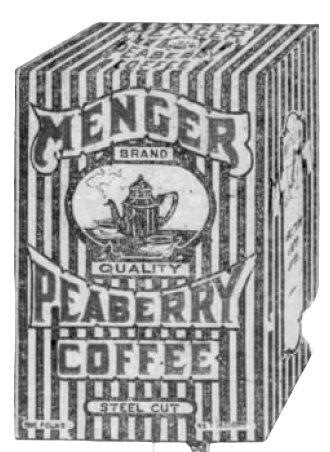
- 26 August 1923 — San Antonio Light special-edition products display names the brand explicitly as “Menger Peaberry Coffee”, illustrated with its own pack art alongside H and H Coffee, Tea, Spices, Cocoa, and Border (full page documented at the 1923 Light products-ad slug). The rename to Menger Peaberry likely happened in the 1920–1923 window after Gus P. Menger took control of the firm — plausibly a deliberate family-branding choice, though the exact rebrand date is not yet pinned down.
- 28 November 1926 — San Antonio Light “Largest Coffee Plant” feature lists MENGER PEABERRY among the firm’s high-grade roasted coffees alongside H and H Blend, Sam Houston, Broncho, Border, and Texco.
- 21 December 1932 — San Antonio Express-News Delaware Street Open House coverage names “Menger Brand Peaberry” among the coffees packed at the new plant (“the famous Menger Brand Peaberry and Sam Houston Coffee”). The variant name “Menger Brand Peaberry” (with “Brand”) appears here; treat as a typesetting / copy variant of Menger Peaberry.
After 1932 the brand fades from the surviving advertising in this collection’s window — by the 1934 30th-anniversary copy the flagship trio is H and H Blend / Sam Houston / Texas Girl, and Menger Peaberry is no longer named. The 2 March 1942 H&H wholesale bulk-coffee price sheet is decisive: it lists five peaberry-category SKUs (Arrow Peaberry, Standard Peaberry, Perfection Peaberry, Anita Peaberry Blend, O.S.T. Fancy Santos Peaberry) plus the package-tier ANITA Coffee retail line — but no “Menger Peaberry.” The peaberry category continued at bulk and retail scale; the “Menger Peaberry” wordmark specifically did not. Discontinuation is therefore bracketed to 1932–1942, with the 1934 flagship-trio refresh as the strongest single-source signal of the retirement.
The retirement is one of six brands in the documented H&H mid-century brand-attrition cluster (Spoon 1923-only, Border 1926+, Broncho 1926+, Menger Peaberry 1932+, Sam Houston 1935+, Anita 1942+) that did not make it into the 1960 corporate product roster (Master Chef, Master Chef Instant, H and H Coffee, Texas Girl).
Products
From collector priorities and period branding—not yet from a labeled tin in this gallery:
- Menger Peaberry Coffee — one-pound tin (explicitly listed on Wanted)
- Menger Peaberry Coffee — larger tin (second size) — inferred from the 10 March 1934 The News product display (post), which shows 2 Menger Peaberry cans of different heights alongside other H&H brands stacked by size. No specimen documented.
Packaging
No Menger Peaberry tin, bag, or label scan has been filed under assets/images/gallery/ with a discoverable “peaberry” filename. When an example arrives, photograph it and embed it here using Sam Houston Coffee or Broncho Coffee as layout models.
Advertising & ephemera
The postcard below is the same asset used on the Sam Houston and Broncho brand pages: it is company advertising art, not proof of a specific tin shape, but it does show how “Menger Peaberry Coffee” was lettered with the other house brands.
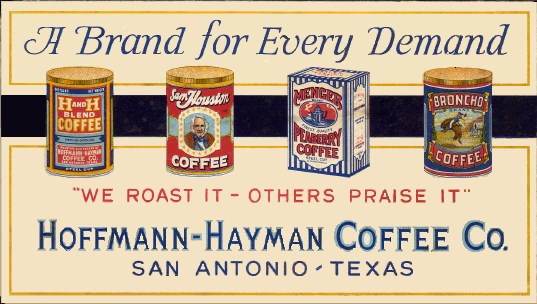
Mid-1930s newspaper spreads on the site often group Blend, Sam Houston, and Texas Girl; Peaberry may appear in other clippings not yet indexed—worth watching as the Newspaper ads gallery grows.
Reference photography
Retail Menger Peaberry tins are still absent from Our Collection; ephemera above and the 1923 crop below document lettering and layout.
Newspaper & period branding
Menger Peaberry Coffee pack art from the 26 Aug 1923 San Antonio Light products display (full page).
Family & company context
For officers, portraits, and factory-era narrative tied to the Menger side of the business, reuse the same anchor posts as Menger Hotel Coffee:
Related lines
- Menger Hotel Coffee — second Menger-named coffee; different wording on packaging. Together with Menger Peaberry, the two Menger-named coffees mark the post-1920 Menger-family corporate identity on H&H retail packaging.
- Sam Houston Coffee · Broncho Coffee — other brands on the postcard quartet (with H and H Blend, Menger Peaberry, Broncho, and Sam Houston in one Hoffmann-Hayman layout); both also part of the mid-century brand-attrition cluster.
- H and H Blend Coffee — flagship brand also on the postcard quartet; survived to the 1960 corporate roster (as H and H Coffee umbrella) where Menger Peaberry did not.
- Border Coffee · Anita Coffee — sibling 1920s house brands with parallel documented retirement windows (Border 1926+, Menger Peaberry 1932+, Anita 1942+). All three drop out of the 1942 wholesale package sheet.
- Texco Coffee — Morrison-acquired sibling that survived all the way into the 1942 wholesale package sheet (as a TEXCO SKU). Texco-survives / Menger-Peaberry-doesn’t is a discriminating contrast for the brand-attrition pattern.
- Hoffmann-Hayman Coffee Company — corporate hub.
- H and H Product Line — product-family index.
Fancy Peaberry → Menger Peaberry: wordmark transition
The brand’s earliest on-site attestation in the 19 August 1917 Express wholesale roster reads “Fancy Peaberry in 1-lb. cartons” — no “Menger” prefix yet. By the 26 August 1923 Light products spread the same line is illustrated as “Menger Peaberry Coffee.” The rename window is 1920–1923, plausibly tied to the Menger family takeover of Hoffmann-Hayman after Gus P. Menger took control of the firm in January 1920. The rebrand reads as a deliberate family-branding choice — applying the Menger surname to the existing Fancy Peaberry line as part of post-merger consolidation. The exact rebrand date is undocumented; a 1921–1922 H&H ad or sales sheet naming the brand either as “Fancy” or “Menger” would tighten the bracket.
The 21 December 1932 Express-News Delaware Street plant-opening copy uses a third variant: “Menger Brand Peaberry” (with an explicit “Brand” suffix between “Menger” and “Peaberry”). This may be a typographic / copy variant of the same wordmark, or it may signal a late-1932 wordmark refresh tying the brand to “Menger” as a quasi-trademarked family designation distinct from the 1923 “Menger Peaberry Coffee.” After 1932 the wordmark drops out entirely; by 1942 the peaberry category continues only under unrelated bulk-tier SKUs (Arrow / Standard / Perfection / O.S.T. Fancy Santos / Anita Peaberry Blend).
Documented absence after 1932
Menger Peaberry is documented through the 21 December 1932 Delaware Street plant-opening piece and then absent from every subsequent on-site source:
- 12 October 1934 “30 Successful Years” anniversary copy — names the flagship trio as H and H Blend, Sam Houston, Texas Girl. No Menger Peaberry. The 1934 flagship reshuffling is the strongest single-source signal of the brand’s retirement.
- 2 March 1942 H&H wholesale package and bulk price sheet (“FOR TEXAS ONLY”) — package SKUs: H AND H, SAN ANTONIO, TEXAS GIRL, ANITA, TEXCO, BIG VALUE, M. CHEF. Bulk lines: Economy Blend Cereal and Coffee, Good Rio, Big Gum, Arrow Peaberry, Standard Peaberry, Perfection Peaberry, Blue Bird, Anita Peaberry Blend, Good Value, O.S.T. Fancy Santos Peaberry. No “Menger Peaberry” in either tier — though the bulk sheet documents five unrelated peaberry SKUs. The peaberry category continued; the Menger Peaberry wordmark did not.
- 23 December 1942 – 23 July 1943 Flav-O-Tainer ad campaign — H&H Drip Grind wartime cellophane-bag ads. No Menger Peaberry.
- 7 November 1957 San Antonio Express Master Chef Instant Coffee launch. No Menger Peaberry.
- 20 February 1959 Valley Morning Star (Harlingen) p. 20 Burpee Flower Garden coupon. No Menger Peaberry.
- 5 May 1960 San Antonio Express-News — Albert Menger president corporate product roster (“Master Chef Coffee, Master Chef Instant Coffee, H and H Coffee, Texas Girl Coffee and other consumer and [institutional] coffee”). No Menger Peaberry (could be inside the “other consumer … coffee” residual but not named — significant given that the corporate roster is named by a Menger family president).
- 27 May 1964 Fredericksburg Standard p. 3 grocery price block. No Menger Peaberry.
The brand’s exit window is therefore 1932–1942 with the 1934 flagship-trio shift as the documented signal. Hypotheses for the discontinuation (see Open questions below): rolled into one of the 1942 bulk Peaberry SKUs, retired entirely as redundant within the post-1932 H&H portfolio, or transitioned to a hotel/restaurant-only SKU parallel to Menger Hotel Coffee.
Open questions
- When exactly was the Fancy Peaberry → Menger Peaberry rebrand? The 1920–1923 window is bracketed by the surviving on-site sources but a 1921–1922 H&H ad or sales sheet would tighten it. The rebrand was plausibly tied to Gus P. Menger’s January 1920 takeover of the firm, but the documented evidence chain has a 3-year gap.
- What is the “Menger Brand Peaberry” variant, and when did it start? Dating extended (2026-07-21): the 14 February 1930 “CLIP THIS COUPON” ad (
HH-CLIP-1930-0008) already uses “Menger Brand” — pushing the earliest attestation back nearly three years from the 21 Dec 1932 Delaware Street plant-opening copy (which uses the three-word “Menger Brand Peaberry”). Is this a typographic/copy variant of “Menger Peaberry Coffee” or a deliberate wordmark used in parallel from at least 1930? A surviving 1930–1934 tin or sales sheet with the “Menger Brand” wording would discriminate. - Was Menger Peaberry rolled into one of the 1942 bulk Peaberry SKUs? The 1942 bulk sheet lists Arrow, Standard, Perfection, Anita Peaberry Blend, and O.S.T. Fancy Santos Peaberry as five distinct peaberry SKUs. Any of these could be the Menger Peaberry recipe under a new name — the Fancy Peaberry → Menger Peaberry → “Standard Peaberry” or “Perfection Peaberry” trajectory is plausible. An intermediate 1933–1941 price sheet would help discriminate.
- Did Menger Peaberry continue as a hotel/restaurant SKU after 1932? Menger Hotel Coffee is a sibling Menger-named line specifically for hotel/restaurant trade. Menger Peaberry may have been folded into the hotel/restaurant channel under the Menger Hotel banner, or retired entirely from retail while continuing as a Menger Hotel ingredient. A 1933–1942 hotel-trade sales sheet would clarify.
- Is the postcard quartet (Blend / Sam Houston / Menger Peaberry / Broncho) dated? The postcard is undated but the four-brand combination is consistent with a mid-1920s to early-1930s window — after the 1920–1923 rebrand to Menger Peaberry, before the 1932+ Menger Peaberry attrition. A dated copy or a printer’s mark would anchor the postcard chronologically.
Wanted
- Menger Peaberry Coffee one-pound tin (any grind or lid variant)
- Larger or smaller retail units if they exist under the same trade name
- Menus, hotel lists, or ads that spell out Menger Peaberry service outside generic “H and H” copy
- Coupon-redemption dishware (Feb 1930 — oatmeal bowl, pie plate, or fruit dish; see Premiums § February 1930) — no specimen identified
Contributed photographs only still advance the museum—see contact.